
What Is Impermanent Loss?
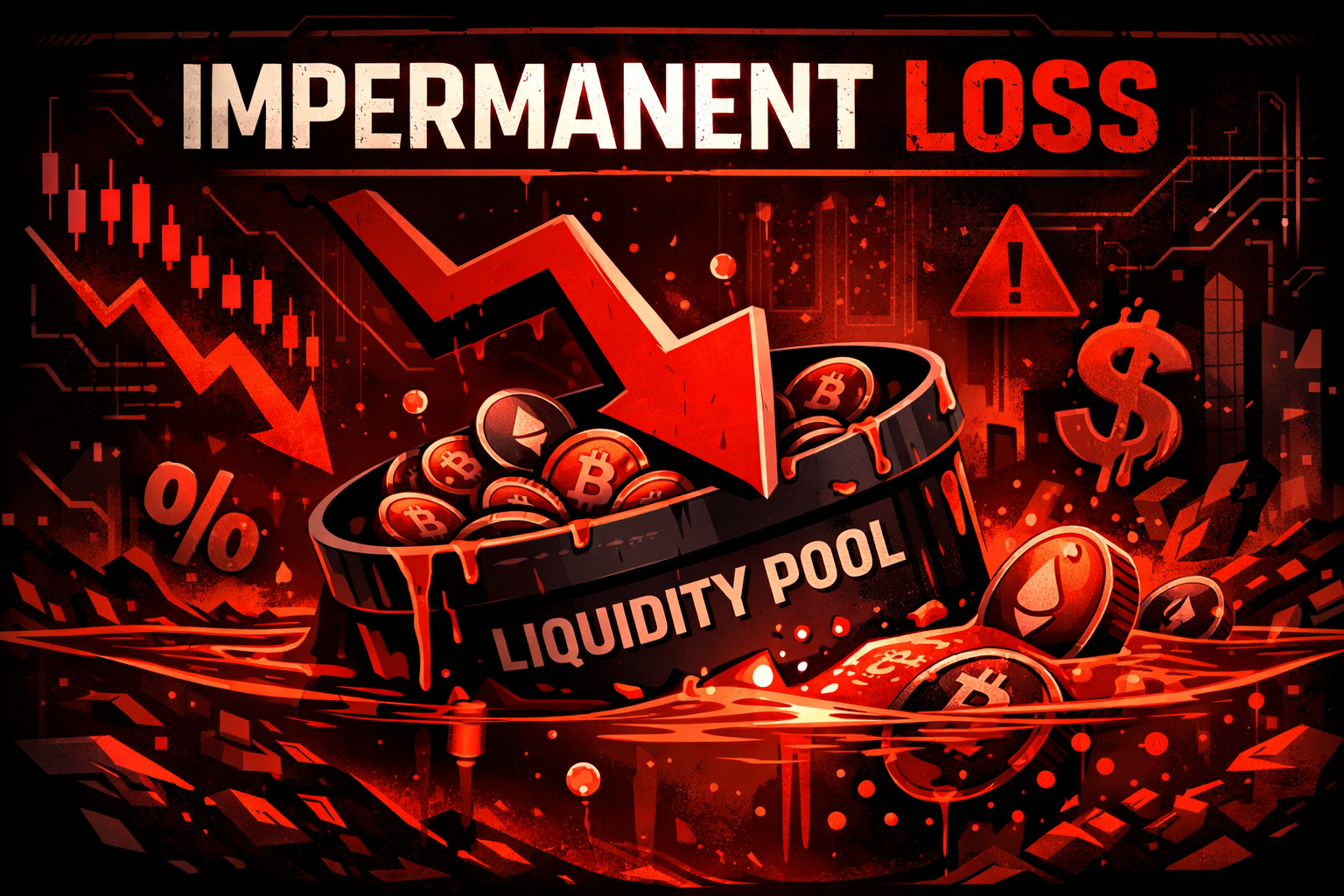
Impermanent loss is a phenomenon that affects users who provide liquidity to decentralized exchanges (DEXs) such as Uniswap, SushiSwap, or Curve.
It occurs when the price of the two assets in a liquidity pool changes relative to the price at which they were deposited. The loss is called “impermanent” because it only becomes permanent if the liquidity provider withdraws their funds while the price ratio remains altered.
In simple terms:
If you had simply held the tokens in your wallet instead of providing liquidity, you would sometimes have more value than what you receive when withdrawing from the pool.
Why Impermanent Loss Happens
Decentralized exchanges use Automated Market Makers (AMMs) instead of traditional order books. The most common AMM model is the constant product formula:
x × y = k
Where:
-
x = amount of token A
-
y = amount of token B
-
k = constant
When the price of one token increases significantly relative to the other, arbitrage traders rebalance the pool by buying the undervalued token and selling the overvalued one.
As a result:
-
The pool composition changes.
-
Liquidity providers end up holding more of the underperforming asset and less of the outperforming asset.
This is the mechanical source of impermanent loss.
Practical Example
Suppose you deposit:
-
1 ETH (worth $2,000)
-
$2,000 in USDC
Total value: $4,000.
Now imagine ETH doubles to $4,000.
If you had simply held:
-
1 ETH = $4,000
-
$2,000 USDC
Total = $6,000.
However, inside the AMM pool, arbitrage forces rebalancing. You will end up with:
-
Less ETH
-
More USDC
When you withdraw, you might receive approximately $5,657 instead of $6,000.
The difference ($343) is impermanent loss.
The Formula Behind Impermanent Loss
Impermanent loss can be calculated as:
IL = 2 × sqrt(price_ratio) / (1 + price_ratio) − 1
Where:
price_ratio = new price / initial price
The larger the price divergence, the larger the impermanent loss.
When Does It Become Permanent?
Impermanent loss becomes permanent when:
-
You withdraw liquidity while prices remain divergent.
-
The price ratio does not return to its original level.
If the prices revert to their initial ratio before withdrawal, the impermanent loss disappears.
However, in volatile markets, this reversion is not guaranteed.
Fees vs Impermanent Loss
Liquidity providers earn trading fees from the pool.
In many cases:
Trading fees can offset impermanent loss.
But this depends on:
-
Trading volume
-
Volatility
-
Pool size
-
Incentive rewards (token emissions)
High volatility with low volume can result in net losses.
Risk Profile
Impermanent loss risk is:
-
Higher in volatile token pairs
-
Higher in low-liquidity pools
-
Lower in correlated pairs (e.g., stablecoin pairs)
Stablecoin pools like USDC/USDT typically experience minimal impermanent loss because price deviation is small.
Correlated vs Uncorrelated Assets
Correlated Pair (Low IL Risk)
ETH / stETH
USDC / USDT
Uncorrelated Pair (High IL Risk)
ETH / random altcoin
BTC / memecoin
The more extreme the divergence, the higher the impermanent loss.
Advanced Considerations
1. Concentrated Liquidity (Uniswap v3)
In Uniswap v3, liquidity providers can choose specific price ranges.
If the price moves outside the selected range:
-
The position becomes 100% one asset.
-
Impermanent loss can increase dramatically.
2. Yield Farming Incentives
Some protocols compensate IL risk through:
-
Token rewards
-
Liquidity mining incentives
However, these rewards can introduce additional volatility risk.
Real-World Example: Uniswap
Uniswap is the largest AMM-based DEX.
Official documentation:
https://docs.uniswap.org
Academic discussion on AMMs:
https://arxiv.org/abs/2003.10001
Impermanent loss explanation by Binance Academy:
https://academy.binance.com/en/articles/impermanent-loss-explained
How to Mitigate Impermanent Loss
-
Choose correlated asset pairs
-
Prefer high-volume pools
-
Avoid extremely volatile token pairs
-
Monitor market conditions
-
Use IL calculators before depositing
Example calculator:
https://dailydefi.org/tools/impermanent-loss-calculator/
Comparison: Holding vs Providing Liquidity
Holding:
-
Exposure to price appreciation
-
No fee income
-
No IL risk
Providing liquidity:
-
Fee income
-
Exposure to IL
-
More complex risk dynamics
Liquidity provision is not passive yield. It is active risk exposure.
FAQ
Is impermanent loss a bug?
No. It is a structural consequence of the AMM pricing model.
Does impermanent loss only affect DeFi?
Yes. It is specific to automated market maker pools.
Can impermanent loss exceed 100%?
No. It is always less than the total value deposited.
Is impermanent loss always negative?
Yes. By definition it compares performance versus holding.
Common Misconceptions
“Impermanent loss means I lose money immediately.”
No. It only becomes realized when you withdraw while prices have diverged.
“High APY eliminates impermanent loss.”
Not necessarily. High APY often correlates with higher volatility.
“Stablecoin pools have no risk.”
Stablecoin depegging events can still cause losses.