

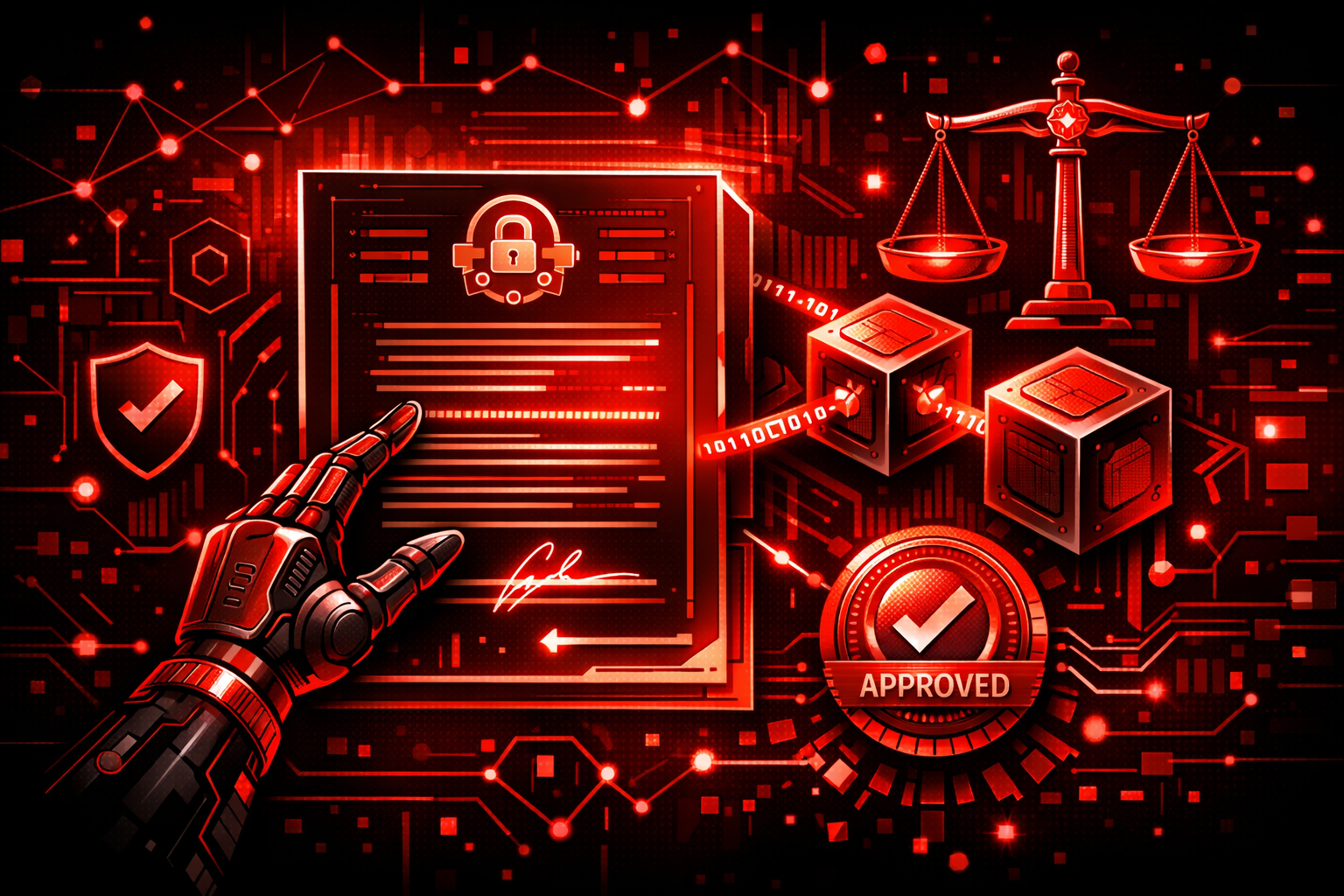
What Is a Smart Contract?
A smart contract is a piece of code deployed on a blockchain that automatically executes actions when specific conditions are satisfied. Unlike traditional contracts written in legal language and enforced by courts or intermediaries, smart contracts are enforced by code and blockchain consensus.
Once deployed, a smart contract runs exactly as programmed. It cannot be altered without deploying a new version, and its execution is publicly verifiable on the blockchain.
Smart contracts remove the need for trusted third parties in many digital interactions by replacing institutional trust with deterministic code.
How Smart Contracts Work
At a technical level, a smart contract is:
-
Written in a programming language (e.g., Solidity on Ethereum)
-
Deployed to a blockchain network
-
Assigned a unique address
-
Triggered by transactions or external inputs
The process typically follows this flow:
-
A user sends a transaction to the smart contract.
-
The contract evaluates predefined conditions.
-
If conditions are met, the programmed logic executes.
-
The result (token transfer, state update, minting, etc.) is recorded on-chain.
Execution is validated by network nodes according to the blockchain’s consensus mechanism (e.g., Proof of Stake).
Key Characteristics
-
Autonomous execution
-
Immutability after deployment
-
Transparency of logic (in public blockchains)
-
Deterministic outcomes
-
No centralized authority
Smart contracts do not interpret intent. They execute logic exactly as written.
Why Smart Contracts Matter
Smart contracts are the foundation of decentralized finance (DeFi), NFTs, DAOs, and many blockchain-based systems.
They enable:
-
Decentralized exchanges (DEXs)
-
Lending and borrowing protocols
-
Automated token issuance
-
Governance systems
-
Escrow mechanisms without intermediaries
In traditional systems, these processes require banks, brokers, lawyers, or centralized platforms. In blockchain systems, smart contracts replace institutional enforcement with programmable logic.
Real-World Example
On Ethereum, decentralized exchanges like Uniswap rely entirely on smart contracts to manage liquidity pools and token swaps. When a user swaps one token for another, the smart contract automatically calculates the price and executes the transaction without a centralized operator.
NFT marketplaces also use smart contracts to:
-
Mint tokens
-
Enforce royalty payments
-
Transfer ownership
Bitcoin does not support complex smart contracts in the same way Ethereum does, but it includes simpler programmable conditions through its scripting language.
Risks and Limitations
Smart contracts introduce new forms of risk:
Code Vulnerabilities
Bugs in the contract code can be exploited. Once deployed, fixing errors is difficult.
Irreversibility
If a smart contract executes incorrectly, transactions usually cannot be reversed.
Oracle Dependency
Some contracts rely on external data feeds (oracles). If the oracle is compromised, contract execution may be flawed.
Legal Ambiguity
Smart contracts do not automatically replace legal contracts in all jurisdictions. Their legal enforceability varies.
Economic Exploits
Even correctly written contracts can be exploited through complex financial strategies (e.g., flash loan attacks).
Smart contracts eliminate certain intermediary risks but introduce technical and systemic risks.
Smart Contract vs Traditional Contract
| Traditional Contract | Smart Contract |
|---|---|
| Written in legal language | Written in code |
| Enforced by legal system | Enforced by blockchain |
| Requires intermediaries | Peer-to-peer execution |
| Subject to interpretation | Deterministic execution |
Smart contracts do not replace legal systems entirely. They automate predefined logic within blockchain environments.
Technical Structure (Simplified)
A typical smart contract includes:
-
State variables
-
Functions
-
Access control rules
-
Event logs
-
Conditional logic
In Ethereum, contracts are executed by the Ethereum Virtual Machine (EVM), which ensures that every node processes the same logic consistently.
Where Smart Contracts Are Used
-
DeFi protocols
-
NFT marketplaces
-
Token issuance
-
Stablecoin systems
-
DAO governance
-
Supply chain automation
Their adoption depends on blockchain scalability, cost efficiency (gas fees), and regulatory clarity.
Authoritative Resources on Smart Contracts
For a deeper and more technical understanding of smart contracts, you can consult the official documentation of the Ethereum Foundation:
https://ethereum.org/en/developers/docs/smart-contracts/
If you want to understand how smart contracts are actually written and deployed, the Solidity documentation is essential:
https://docs.soliditylang.org/
For foundational context, the original Ethereum whitepaper by Vitalik Buterin remains a key reference:
https://ethereum.org/en/whitepaper/
Finally, for security best practices, contract audits, and production-ready libraries, OpenZeppelin provides industry-standard resources:
https://docs.openzeppelin.com/
Common Misconceptions
“Smart contracts are legally binding contracts.”
Not necessarily. They are programs. Legal recognition depends on jurisdiction.
“Smart contracts cannot be hacked.”
They can be exploited if poorly written.
“Smart contracts are fully autonomous.”
Many depend on external inputs such as price feeds or human-triggered transactions.
“Smart contracts eliminate all trust.”
They shift trust from institutions to code quality, audits, and network security.


