

Introduction
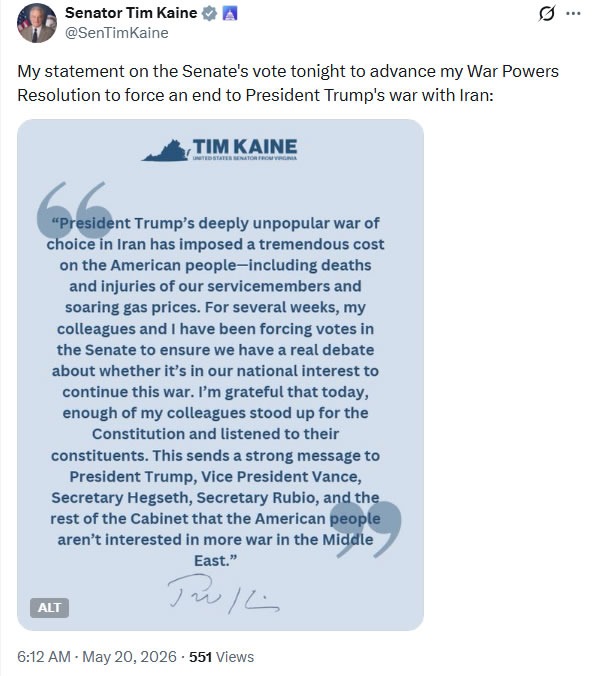
The United States Senate has recently taken a significant step by voting 50-47 to advance a war powers resolution aimed at curbing President Donald Trump's military actions in Iran. This resolution is pivotal as it seeks to enforce congressional approval for any continued military engagement in the region, a move that many lawmakers argue is necessary to uphold the constitutional powers granted to Congress.
The Context of the Resolution
For nearly three months, tensions between the United States and Iran have escalated, leading to military actions that have raised concerns among lawmakers and citizens alike. The resolution, championed by Democratic Senator Tim Kaine, emphasizes the need for Congress to have a say in military deployments. Senator Kaine stated, “Congress has the power to slam the brakes on this unwise conflict.” This sentiment reflects a growing bipartisan concern regarding the executive branch's authority to engage in military actions without legislative oversight.
Implications for U.S. Foreign Policy
The implications of this resolution extend beyond the immediate conflict. As the U.S.-Iran war continues, global economies are feeling the pressure, particularly with rising fuel and energy prices due to the closure of the Strait of Hormuz. This strategic waterway is crucial for oil transportation, and any disruptions can lead to significant economic ramifications worldwide.
Furthermore, the resolution could potentially lead to a withdrawal of U.S. troops from Iran, contingent upon congressional approval. However, this is not without its challenges. The bill must also pass through the Republican-led House of Representatives, and President Trump has the option to veto it, which would require a two-thirds majority in both chambers to override.
The Political Landscape
As the political landscape evolves, several key figures have voiced their opinions. Republican Senator Bill Cassidy remarked on social media about the lack of transparency from the White House regarding military operations, stating, “While I support the administration’s efforts to dismantle Iran’s nuclear program, the White House and Pentagon have left Congress in the dark on Operation Epic Fury.” This highlights the ongoing debate within Congress about the balance of power between the executive and legislative branches.
Economic Considerations
The ongoing conflict has also affected the cryptocurrency market, which has struggled to recover amid rising inflation and geopolitical tensions. Analysts suggest that if the war with Iran de-escalates, it could lead to a positive shift in market sentiment. Tim Sun, a senior researcher at HashKey Group, noted that easing geopolitical conflicts could drive oil prices down, subsequently lowering valuation risks across various assets.
- Key takeaways:
- The Senate voted to advance a resolution on war powers.
- Congress seeks to limit presidential military authority.
- Tensions with Iran have global economic implications.
- Potential troop withdrawal hinges on congressional approval.
FAQ
What is the war powers resolution?
The war powers resolution is a legislative measure that requires the President to seek congressional approval before engaging in military actions.
How does this resolution affect U.S. troops in Iran?
If passed, the resolution could force the withdrawal of U.S. troops unless the President obtains congressional approval for their continued presence.
What impact could this have on the cryptocurrency market?
Analysts believe that a de-escalation of the conflict could lead to a rally in the cryptocurrency market, as stability often encourages investment.
Sources
For more information, visit the original article on Cointelegraph.