
Introduction
The relationship between Bitcoin (BTC) and software stocks has long been a focal point for investors. For years, these two assets moved in tandem, with Bitcoin often seen as a high-beta technology asset. However, recent developments indicate a significant divergence between the two, prompting questions about the future trajectory of both markets.
The Divergence Explained
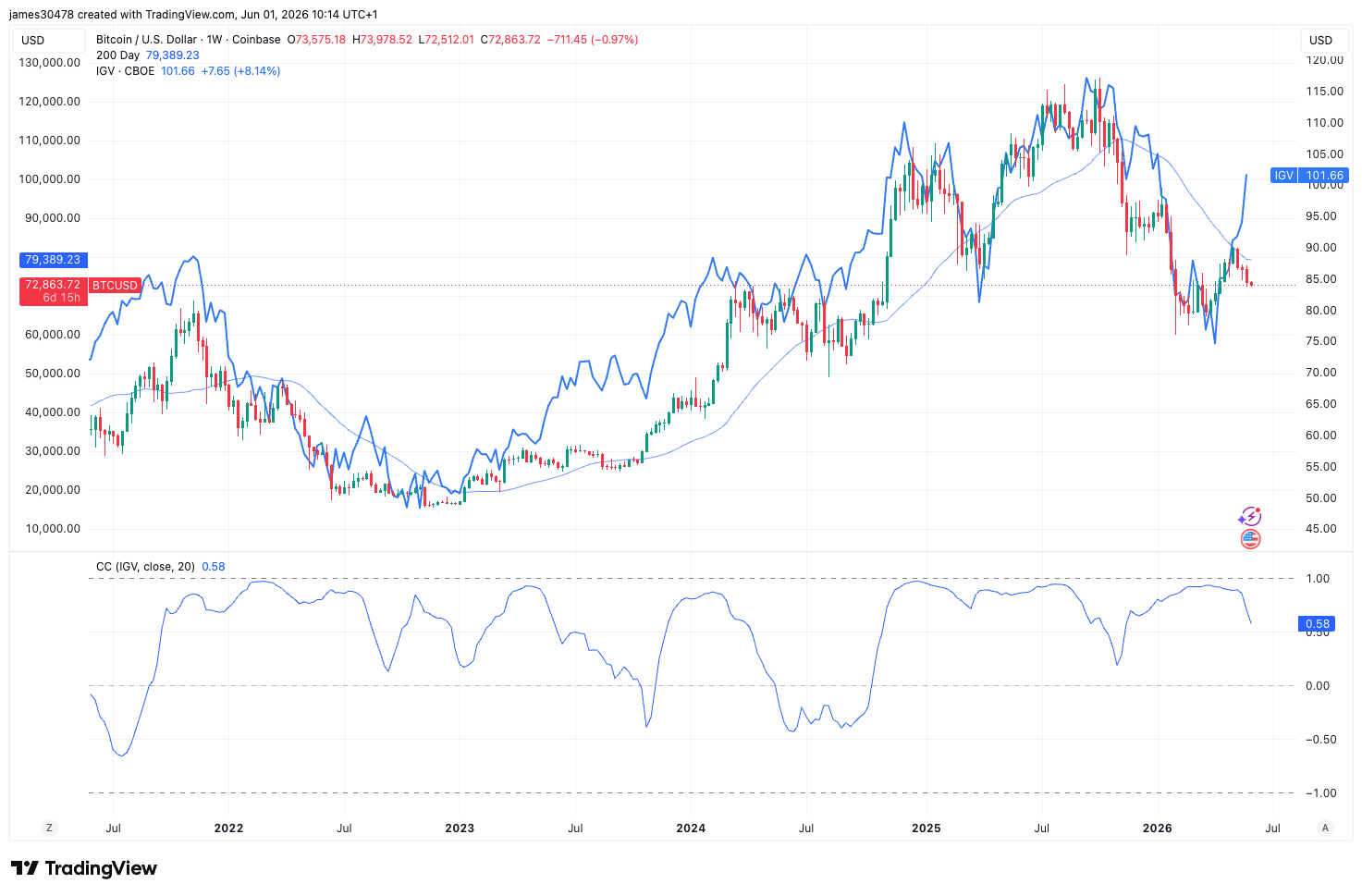
Since mid-May 2026, Bitcoin and the iShares Expanded Tech-Software Sector ETF (IGV) have shown a stark contrast in performance. While IGV has appreciated by approximately 12%, Bitcoin has faced a downturn of about 10%. This disconnect is one of the most pronounced in recent history, suggesting a potential shift in market dynamics.
Historical Context
Historically, Bitcoin and software stocks reached their peaks in October 2025, after which both experienced significant corrections. Bitcoin saw a decline of roughly 50%, while IGV fell around 37%. The decline in the software sector has been attributed to growing concerns that artificial intelligence could disrupt traditional software business models, leading to what some have termed the “SaaS apocalypse.” This narrative has resulted in widespread selling pressure on notable software companies such as Oracle, Microsoft, and Palantir.
IGV's Recovery
Despite the challenges faced by the software sector, IGV has demonstrated resilience, staging a remarkable recovery since early April, rallying by 36%. This rebound has allowed IGV to reclaim its 200-day moving average, a critical technical indicator that many traders use to assess long-term trends. As of the latest trading session, IGV closed near 98, with pre-market action indicating a rise to around 104.
Bitcoin's Current Position
In contrast, Bitcoin is currently trading near $73,000, which is nearly 10% lower than its own 200-day moving average of approximately $79,388. The correlation between Bitcoin and IGV has dropped to 0.58, reflecting a significant break in their historical relationship. Notably, similar periods of low correlation have preceded substantial rallies in Bitcoin, such as the surge from $25,000 to $70,000 in late 2023 and the climb towards $100,000 in the summer of 2024.
- Key takeaways:
- Bitcoin and software stocks have diverged significantly.
- IGV has shown strong recovery momentum.
- Historical low correlation often precedes Bitcoin rallies.
- Concerns about AI disrupting software models are prevalent.
FAQ
Why are Bitcoin and software stocks diverging?
The divergence is largely due to differing market sentiments and performance trends, with software stocks recovering while Bitcoin has faced declines.
What does a low correlation mean for Bitcoin?
A low correlation suggests that Bitcoin may be poised for a significant move, either catching up to software stocks or continuing its own trend.
How can investors navigate this situation?
Investors should monitor market trends closely, considering both technical indicators and broader economic factors that may influence the performance of these assets.
Sources
For more detailed information, visit the original article on CoinDesk.